Cabinet Cut List Generator

Optimize plywood layouts for kitchen cabinets, vanities, and built-ins.

Generate Your Cut List

How Much Plywood for Kitchen Cabinets?

Planning a kitchen remodel or building custom cabinets? Our free cabinet cut list generator helps you calculate exactly how many sheets of plywood you need - and shows you the most efficient way to cut them.

Example: 10-Cabinet Kitchen

A typical 10-cabinet kitchen with base cabinets, wall cabinets, and a pantry might require 8-12 sheets of 3/4" plywood for carcasses, plus 2-3 sheets for face frames or backs. Our optimizer can reduce that by 1-2 sheets through efficient nesting.
CutCalc parts list for cabinet project
Enter your cabinet parts and let CutCalc optimize the layout

Standard Cabinet Box Parts

Cabinet Type Typical Parts Common Sizes
Base Cabinet (24"D) 2 sides, 1 bottom, 1 back, 1 stretcher Sides: 23.25" x 34.5"
Wall Cabinet (12"D) 2 sides, top, bottom, back Sides: 11.25" x 30"
Drawer Box 2 sides, front, back, bottom Varies by opening

Features for Cabinet Makers

Grain Direction

Keep wood grain running the right direction on visible cabinet sides and doors.

Multiple Materials

Separate cut lists for 3/4" carcass plywood, 1/4" backs, and 1/2" drawer boxes.

Kerf Compensation

Accounts for blade thickness so your parts come out the right size.

Labels on Diagrams

Each part labeled on the cutting diagram - no confusion at the saw.

Plywood Buying Guide for Cabinets

Which Plywood for Cabinet Boxes?

Material Estimates by Kitchen Size

Kitchen Size 3/4" Sheets 1/4" Sheets
Small (8-10 cabinets) 6-8 sheets 2-3 sheets
Medium (12-15 cabinets) 10-14 sheets 3-4 sheets
Large (18+ cabinets) 16-22 sheets 5-6 sheets

Note: These are rough estimates. Use our calculator for exact quantities based on your specific cabinet dimensions.

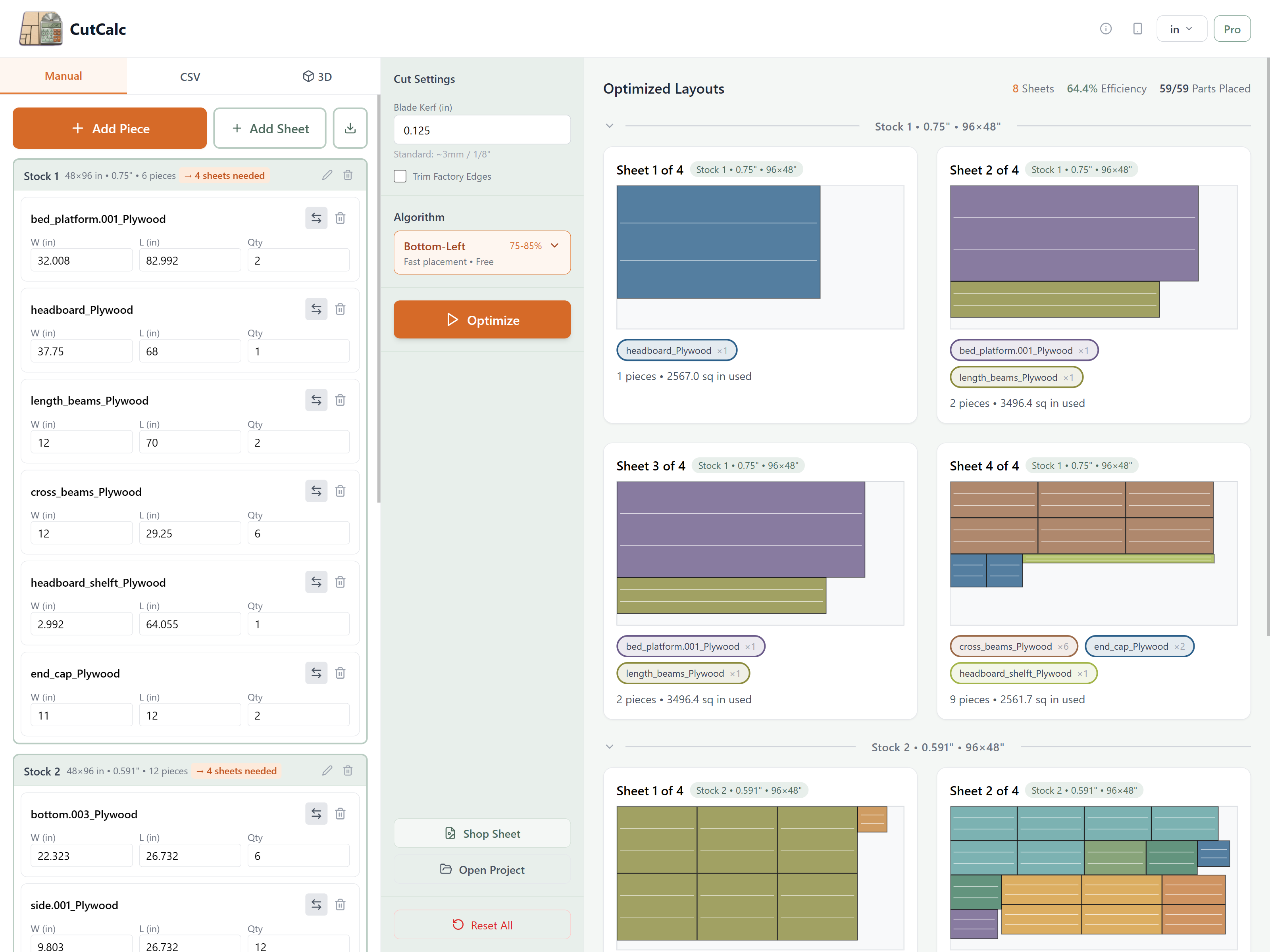
CutCalc optimized cutting diagram for cabinet parts
Visual cutting diagram you can take straight to the shop

Tips for Efficient Cabinet Cutting

  1. Group by thickness - Cut all 3/4" parts, then all 1/4" parts
  2. Cut large parts first - Sides and bottoms before small parts
  3. Save quality offcuts - Useful for jigs, test pieces, and small parts
  4. Label as you cut - Mark each part with its cabinet number and position
  5. Account for edgebanding - If applying 1mm edgeband, your parts may need slight adjustment

Build Smarter, Waste Less

Get your optimized cabinet cut list in seconds.

Start Your Cut List - Free